


Lace Jewels
14K Victorian Essex Crystal Moose Pendant
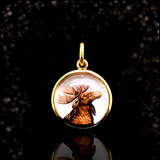
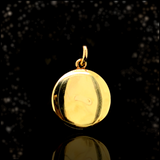
An exceptional Victorian c.1890–1900 Essex crystal pendant, featuring a Moose (Alces alces) reverse carved beneath rock crystal, painted and backed with mother of pearl, and modelled in 14k gold.
An Essex crystal is formed from a domed rock crystal (quartz) cabochon that has been meticulously reverse carved and then painstakingly hand painted, creating the remarkable illusion of a three-dimensional miniature encapsulated within the cabochon. This demanding technique requires both skilled engraving and fine brushwork, and was highly prized during the Victorian period.
The Moose (Alces alces) is one of the most distinctive animals of the Northern wilderness, known for its towering height, long pendulous muzzle, and impressive palmate antlers that broaden with age. Its silhouette is unmistakable; A deep-shouldered frame, a sweeping backline, and a calm, deliberate gait often described in Victorian field notes as “majestic in stillness.” Nineteenth-century natural history artists frequently illustrated the moose for its remarkable proportions and quiet, solitary presence in boreal forests. Its rendering in an Essex crystal miniature speaks to the Victorian fascination with unusual and characterful wildlife, making this subject especially striking in jewellery of the period.
It is important to note that this example is carved from genuine rock crystal quartz from the Victorian era, and is far more valuable and durable than the glass and later plastic imitations that flooded the market in the c.1920s.
It was originally a cufflink that has been expertly converted into a wearable pendant. It can be worn on its own or layered with other charms, and is offered in excellent condition.
This pendant would be a wonderful addition for antique lovers with an appreciation for woodland animals, as it represents both exceptional craftsmanship and a tangible collectible of late 19th century history.
It measures 15mm x 21mm with bail, 15mm x 15mm without bail, and weighs 2.64 grams.
Note: Please note that as an Essex crystal contains a hand painted reverse intaglio, it is advisable that the piece does not get wet or exposed to water. It can be gently cleaned by wiping it down with a wrung out damp cloth.
About Essex Crystal - Reverse Crystal Intaglio
"A reverse crystal intaglio is a rock crystal cabochon with an intaglio carved into the flat back (instead of the top as done previously.) The intaglio was also painted realistically with oils so, that when viewed through the top, the image appears three-dimensional. Finally, the back was sealed in order to preserve the painted areas. The technique originated in Belgium c. 1860 and is attributed to an artist named Emile Marius Pradier. It is notable to mention that collectors of Mr. Pradier’s work occasionally find his signature on his earliest creations. This technique was popularized in England by Thomas Cook who made crystals for Lambeth & Co. The popularity of the genre encouraged Mr. Cook to train an apprentice, Thomas Bean, to assist in the process. Bean’s son and grandson carried on the tradition of reverse crystal intaglio production keeping the secrets of this mysterious process all in the family.
Production of a reverse crystal intaglio begins with the mining and cutting of fine rock crystal from Brazil or Madagascar. A well-formed cabochon is the key to a beautifully made reverse intaglio and the tedious process of hand polishing it to perfection had to be completed before the design work could begin. A watercolor rendering of the image was painted on the underside of the cabochon and an oil and diamond dust mixture was used along with up to 250 scribing tools to carve the design into the interior of the crystal “…the deeper the carving the more pronounced trompe l’oeil effect.”1 Once the carving was established the painting process began with extremely fine brushes and paint working in reverse to create incredibly detailed images.
The motifs most commonly found for men were sporting themes – horses, dogs, foxes and birds and for women – monograms, birds, insects (especially popular at this time because of the association with the Bonapartes and their bee emblem,) butterflies and flowers. Reverse crystal intaglios were set as stickpins, buttons, and studs, mounted on tie pins, cuff links, lockets and charms. Occasionally back-to-back mounted crystals resulted in an orb-like crystal with the image apparently “floating” in its center. This relatively secret process, with its techniques passed through family members, kept it exclusive and expectations of quality were very high. They remained in fashion until poorly made glass and plastic imitations flooded the market c. 1920s.
Layaway Information
A 5-6 part monthly payment is available for this product.
There is no additional fee and it will be the same cost to purchase.
If you'd like to secure this piece on layaway, please Contact Us with: [The name of the piece(s) you would like a layaway on] + [The number of monthly payments you require]
Shipping is only added on the last layaway payment.
You may also email us at contact@lace-jewels.com. Alternatively, send us a DM on Instagram : @lace.jewels and we will set up the listing for you to pay a monthly payment.
If you absolutely require a longer layaway than stated, we can help too! Please get in touch, and we will work out a best option for you.
Read more about our Layaway process & terms here.
360° Video
We provide an all-around view of most of our pieces in a 360° video for a better viewing experience.
To view a 360° video for a product, scroll all the way to the end of the product images and click the Play button.
Please note that videos have a longer loading time, and may buffer for a while before playing.
(If you are unable to get the video to load, please Contact Us, and we will send you a link to view the video by email)